-1.png?width=787&height=440&name=file%20(2)-1.png)
Growth does not come from adding more tools. It comes from making the business applications you already use work together.
Most organisations rely on several business applications across finance, HR, sales, operations, and reporting. Each application does its job well on its own, but problems start when data needs to move between them. Manual work appears. Data arrives late. Decisions are made with incomplete information.
This is where integration becomes a growth driver rather than a technical task.
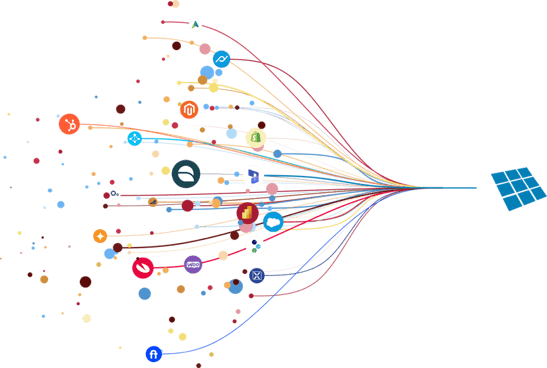
An integration platform as a service, often referred to as iPaaS, connects business applications so data moves automatically, accurately, and on time. Instead of people moving data between applications, the work happens in the background.
Why connected applications matter for growth
Growth today depends on speed, accuracy, and confidence in data.
When business applications are connected, information flows freely across the organisation. Decision makers see the same numbers. Teams act on the same data. Reporting reflects reality rather than estimates.
For example, when sales data is automatically available in finance and operations, forecasts become more reliable. When HR data is shared with payroll and workforce planning, hiring decisions improve. When operational data feeds reporting in real time, leadership can respond faster to risks and opportunities.
Disconnected applications slow organisations down. Connected applications create momentum.
Better decisions start with better data
Modern businesses run on data, but data only has value when it is available at the right time and can be trusted.
Integration removes data silos and reduces delays caused by manual updates and spreadsheet based work. Instead of waiting for reports to be compiled, teams work with current information throughout the day.
Research consistently shows that delayed or unreliable data limits performance. Organisations that invest in structured integration are more likely to have clear data ownership, stronger governance, and faster decision making.
When business applications are connected properly, people spend less time questioning numbers and more time acting on them.
Freeing people to focus on real work
Manual data handling is one of the most common hidden costs in growing organisations.
Employees spend hours every week exporting files, copying values, checking formats, and fixing errors. This work does not create value. It only keeps processes running.
By connecting business applications through automation, this manual effort disappears. Data moves where it needs to go without human involvement.
Marketing teams can focus on campaigns instead of list management. Finance teams can focus on analysis instead of reconciliation. HR teams can focus on people instead of paperwork.
When employees stop maintaining data flows, they start contributing to growth.
Scaling without breaking processes
Growth is rarely predictable. New applications are added. Existing ones are replaced. Volumes increase. Processes evolve.
An integration platform makes this change manageable. New connections can be added without rebuilding everything from scratch. Existing workflows can be adjusted without disrupting daily operations.
This flexibility allows organisations to grow without turning their application landscape into a fragile structure held together by manual fixes.
Instead of integrations becoming a bottleneck, they become an enabler.
Efficiency that shows on the bottom line
Automation is not just about speed. It is about reducing waste.
Fewer errors mean fewer corrections. Fewer manual steps mean lower operational costs. Stable integrations reduce the need for constant troubleshooting.
These efficiency gains add up. The time and cost saved can be redirected towards growth initiatives, product development, or customer experience.
Integration is not an overhead. Done right, it is an investment with measurable return.
Security and compliance built into daily operations
Data security and compliance are no longer optional. They are part of everyday business responsibility.
When business applications are connected through a controlled integration platform, data handling becomes consistent and traceable. Access is managed. Transfers are logged. Compliance requirements such as GDPR are easier to maintain over time.
Instead of relying on ad hoc processes and individual knowledge, organisations gain long term control over how data moves between applications.
How ConnectMyApps supports growth through integration
ConnectMyApps helps organisations connect the business applications they already rely on.
Through our integration platform and managed services, we design, build, and maintain integrations that move data automatically between applications. This allows teams to work with reliable data, reduce manual effort, and scale without disruption.
Some customers build and maintain integrations themselves. Others rely on our team to take full ownership. In both cases, the goal is the same: business applications that work together and support growth rather than slow it down.
Integration as a long term advantage
Connecting business applications is not a one time project. It is a foundation for how a business operates and grows.
When data flows automatically, decisions improve. When processes are stable, teams move faster. When applications work together, organisations stop reacting and start planning.
That is why integration is not just a technical upgrade. It is a strategic decision for growth.